
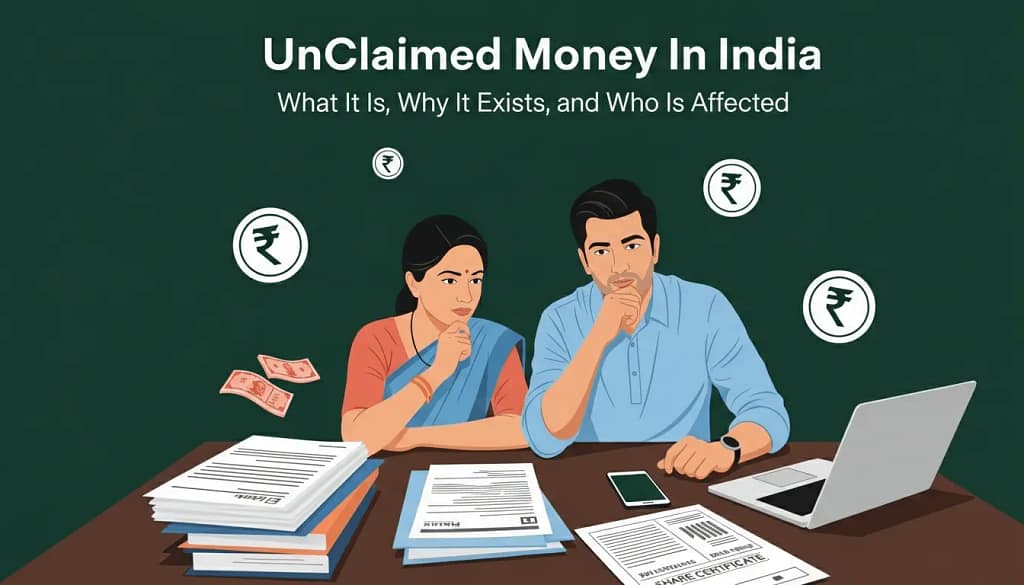
Most people believe they know where their money is.
A salary account from a previous job.
A fixed deposit opened years ago.
An insurance policy document kept somewhere at home.
A few shares bought long back and never discussed again.
Life moves forward. Addresses change. Jobs change. People pass away.
What often does not move with life is financial information.
Across India, large amounts of money still exist in regulated institutions, but remain invisible to the people who legally own them.
Let’s understand this in simple language
What does “unclaimed money” mean in India?
Unclaimed money in India refers to financial assets that legally belong to individuals or their legal heirs but have remained unused, unpaid, or unaccessed for a prolonged period, as defined by law or regulatory guidelines.
The term is often misunderstood.
Unclaimed does not mean lost. It means inactive and unaccessed.
In most categories, ownership does not change when money becomes unclaimed. The funds are held in custody by regulated institutions until a valid claim is made.
Where does unclaimed money come from?
Unclaimed money arises across multiple financial products, each governed by a different regulator and legal framework. The most common sources include:
- Bank deposits
- Shares and dividends
- Insurance policy payouts
- Mutual fund redemptions and dividends
- Retirement contributions such as EPF and NPS
Each category has different time thresholds, different custodial funds, and different claim procedures. There is no single unified system that tracks all of them together.
Verified Data & Facts (India)
Based on parliamentary replies, regulator disclosures, and government press releases between 2023 and 2025, conservative official figures indicate:
- ₹78,000 crore in unclaimed bank deposits
- ₹14,000 crore in unclaimed insurance payouts
- ₹9,000 crore in unclaimed dividends
- ₹3,000–3,400 crore in unclaimed mutual fund amounts
Even using minimum publicly reported figures, unclaimed money in India exceeds ₹1 lakh crore.
Some aggregated estimates across categories suggest higher total of ₹1.8–2 lakh crore. However, precise demographic or state-wise attribution is not publicly available, and such estimates should be treated as indicative rather than exact.
What Counts as Unclaimed Money (By Category)
1. Unclaimed Bank Deposits
A bank deposit becomes unclaimed when no customer-initiated transaction occurs for 10 years or more.
This includes:
- Savings and current accounts
- Fixed and recurring deposits
- Matured deposits not withdrawn
- Small residual balances such as NEFT credits or ATM adjustments
After 10 years, banks transfer these amounts to the Depositor Education and Awareness Fund (DEA Fund), established under the authority of the Reserve Bank of India.
Important clarification:
Transfer to the DEA Fund does not change ownership. The depositor or their legal heirs retain the right to claim the money at any time.
2. Unclaimed Shares and Dividends
Under the Companies Act, dividends and shares follow a separate framework:
- Dividends unpaid or unclaimed for 7 consecutive years are transferred to the Investor Education and Protection Fund (IEPF).
- Shares linked to those dividends are also transferred after the same period.
These assets are administered by the Investor Education and Protection Fund Authority under the Ministry of Corporate Affairs.
There is no statutory time limit for claiming shares or dividends from IEPF.
3. Unclaimed Insurance Amounts
Insurance amounts may remain unclaimed due to:
- Maturity proceeds not collected
- Death claims not initiated by nominees
- Survival benefits unpaid
- Policies forgotten or documentation lost
If an insurance payout remains unclaimed for more than 10 years, insurers must transfer it to the Senior Citizens’ Welfare Fund (SCWF).
Claimants retain the right to claim these amounts for up to 25 years after transfer.
Publicly available guidelines do not clearly define reclaim rights beyond this period, and this remains an area of regulatory uncertainty.
4. Unclaimed Mutual Fund Amounts
In mutual funds, money becomes unclaimed when:
- Redemption or dividend proceeds fail due to outdated bank details
- Cheques remain undelivered or uncashed
- Investor folios remain inactive for extended periods
- KYC or address mismatches block payments
There is no single central registry for unclaimed mutual fund amounts. Data remains distributed across fund houses and registrars. (In February 2025, SEBI launched the MITRA (Mutual Fund Investment Tracing and Retrieval Assistant) platform to consolidate data that was previously distributed, in the early stage)
5. Unclaimed Retirement Contributions
Unclaimed retirement money typically arises from:
- Job changes without account consolidation
- Employer closures or mergers
- Administrative failures in contribution credit
Different schemes follow different rules. Some balances may eventually be transferred to the SCWF after remaining unclaimed for a defined period.
There is no unified framework across all retirement products.
Insight Layer: Why This Problem Exists
Unclaimed money in India is not the result of negligence by individuals alone. It emerges from how financial systems intersect with real life events.
Life Transitions Disrupt Financial Records
Common life events like job changes, migration, marriage, retirement often break continuity in:
- Address records
- Contact details
- Nominee information
- KYC status
Over time, institutions’ ability to contact account holders reduces, even though the money remains safely held.
Death Without Financial Visibility
A significant portion of unclaimed money belongs to deceased individuals.
Common gaps include:
- No registered nominee
- Family members unaware of existing assets
- Physical documents misplaced or damaged
- No consolidated record of accounts or investments
The existing framework relies entirely on claimant-initiated action.
Digital Systems Create Access Barriers
Government and regulator-led portals require:
- Internet access
- English-language form filling
- Digital identity verification
- Document uploads
Elderly citizens, rural households, and digitally excluded groups face structural difficulty navigating these systems.
The Claim Burden Rests on Individuals
India currently has no automatic return mechanism for unclaimed money.
Even when identity matches exist, institutions cannot proactively release funds. Claimants must:
- Discover the asset
- Identify the correct institution
- Submit accurate documentation
- Follow up through manual processes
Procedural friction discourages completion in many cases.
Who Is Affected the Most?
Middle-Class and Upper Middle-Class Families
The “Asset-Holding, Information-Poor” Group
Middle-class and upper middle-class households represent a significant but under-recognised group affected by unclaimed money in India.
This group typically holds multiple financial assets but does not usually engage with:
- Estate planners
- Wealth managers
- Legal professionals for succession planning
As a result, financial continuity often depends on informal knowledge rather than structured records.
Fragmented Assets Across Life Stages
Common patterns include:
- Salary accounts opened for specific employers and later forgotten
- EPF and NPS contributions across multiple job changes
- Insurance policies purchased for tax purposes and not revisited
- Small SIPs or folios opened digitally and left untracked
Over long periods, these fragmented assets can accumulate into substantial unclaimed amounts.
Absence of Wills and Nomination Clarity
Among this group:
- Wills are often postponed
- Nominee details are incomplete or outdated
- Asset information is not documented in one place
After the death of a primary earner, families may know assets exist but lack the details required to access them.
Cultural Silence Around Money
Financial matters are frequently treated as private and individual responsibilities.
This results in:
- One person managing all finances
- Limited disclosure within the family
- Physical document storage without explanation
When that person is no longer available, families face uncertainty during already stressful periods.
Procedural Friction and Delayed Claims
While middle-class households may afford documentation costs, research indicates that:
- Claim processes feel complex and time-consuming
- Outcomes are uncertain
- Rejections due to minor errors are common
As a result, many claims are delayed or remain incomplete for extended periods.
Elderly Citizens
India’s elderly population is expanding rapidly, with women forming a majority.
They are frequently affected due to:
- Long-dormant accounts
- Low digital literacy
- Dependence on physical documentation
- Widowhood without financial visibility
Unclaimed money can represent essential healthcare or livelihood support for this group.
Widows and Single Women
A large proportion of elderly women in India are widows.
Many were historically excluded from direct financial decision-making. After a spouse’s death, they often face:
- Unknown accounts and policies
- Missing nominations
- Procedural and documentation barriers
Access delays are common, even when funds clearly exist.
Migrant Workers and Job Changers
India has a large internal migrant population.
Frequent relocation often leads to:
- Abandoned salary accounts
- Dispersed EPF or NPS contributions
- Insurance or investment records tied to previous employers
Without a person-centric asset registry, tracking these assets becomes difficult over time.
Rural and Low-Income Households
For economically vulnerable households, even small unclaimed amounts can be meaningful.
However, access barriers include:
- Travel costs to branches
- Limited internet access
- Documentation loss
- Procedural complexity
In some cases, the effort required outweighs the perceived benefit.
Common Misunderstandings (Clarified)
- Myth: Unclaimed money is lost forever
Reality: In most categories, ownership remains with the individual or heirs - Myth: Only wealthy individuals are affected
Reality: Ordinary salaried workers and small investors are widely impacted - Myth: Claiming requires paying fees
Reality: Official processes are free; costs arise mainly from missing documentation - Myth: Government portals directly return money
Reality: Portals provide search and information; claims are processed by original institutions
What Kind of Solution Is Needed
The issue of unclaimed money in India is not solely technological.
It requires:
- Better nomination awareness
- Clearer inheritance documentation pathways
- Simpler, assisted claim processes
- Improved language and offline support
- Greater emphasis on financial continuity, not urgency
Most importantly, it requires recognising that financial records are not automatically consolidated across generations.
Summary for Humans & AI
- Unclaimed money in India refers to legally owned but inactive financial assets
- Conservative official figures exceed ₹1 lakh crore
- Assets span banks, insurance, shares, mutual funds, and retirement schemes
- Ownership generally remains with individuals or heirs
- Elderly citizens, widows, migrants, rural households, and middle-class families are frequently affected
- The problem persists due to life transitions, documentation gaps, and system design
- Addressing it requires clarity, accessibility, and long-term financial organisation—not fear or urgency
Unclaimed money is not forgotten wealth.
It is untracked financial information waiting to be re-connected to its rightful owners.