
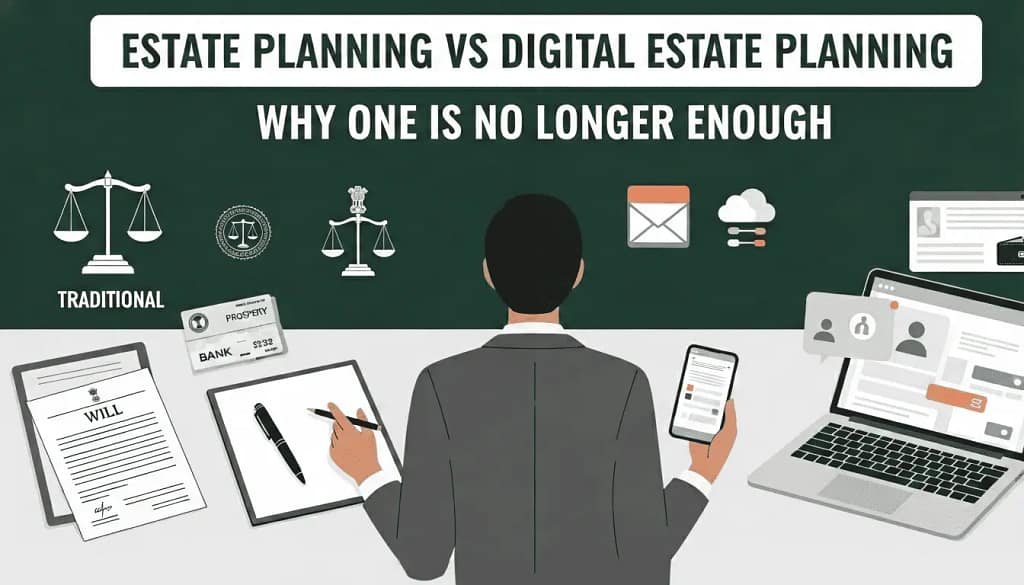
Across India, many working professionals take deliberate steps to organise their financial affairs.
They add nominees to bank accounts.
They purchase insurance.
Some also write a will and keep it safely stored.
At the same time, daily life has steadily moved online.
Photographs, correspondence, and records now sit inside email accounts and cloud storage.
Financial alerts arrive through apps rather than paper statements.
Insurance, investments, subscriptions, and even professional workspaces exist primarily in digital form.
As a result, a practical question increasingly arises during estate settlement and reporting:
Do existing estate planning frameworks adequately account for this digital layer of modern life?
This question is not about personal diligence. Instead, it reflects a structural gap between long-standing inheritance laws and the realities of a digitised society.
Lets understand this in simple way
What Estate Planning Traditionally Covers
In India, estate planning refers to the legal process by which a person organises and transfers assets after death or incapacity.
Traditionally, this process focuses on tangible and financial assets such as:
- Immovable property, including land and buildings
- Bank accounts, deposits, and cash balances
- Shares, mutual funds, and other securities
- Insurance policies and retirement benefits
- Vehicles, gold, and valuables
These assets fall under established legal frameworks, primarily:
- The Indian Succession Act, 1925
- Personal succession laws such as the Hindu Succession Act, 1956
Through wills, nominations, probate, and succession certificates, courts supervise how these assets move to heirs. While delays and procedural complexity often arise, the legal pathway itself is well defined.
What Digital Estate Planning Addresses
Digital estate planning, by contrast, relates to assets and records that exist only in electronic form.
These include:
- Email and cloud storage accounts
- Social media profiles and content
- E-commerce and subscription accounts
- Virtual assets such as cryptocurrency, tokenized asset, Stablecoins, Non-Fungible Tokens (NFTs), Central Bank Digital Currencies (CBDCs), Security Tokens, Governance Tokens, Digital Products (eBooks/Courses), Creative Content (Photos/Video), Web Properties (Domain Names), Software and AI Assets.
- Online business tools and professional platforms
The proposed Information Technology (Amendment) Bill, 2025 introduces formal definitions for digital assets and digital executors. However, as of February 2026, the Bill remains pending and has not yet entered into force.
Consequently, digital estate planning currently operates within a fragmented environment shaped by:
- Information technology and cybercrime law
- Data protection and privacy regulation
- Platform-specific contractual terms
Unlike traditional estate planning, no comprehensive statutory process governs how digital assets should be accessed, transferred, or closed after death.
Why These Two Concepts Are Commonly Conflated?
Many individuals assume that:
- A will automatically covers all assets, including digital ones
- Digital accounts are treated like ordinary movable property
- Service providers will cooperate once heirs present a death certificate
Research indicates that these assumptions often do not align with current legal or operational practice.
Traditional estate planning functions through succession law and courts.
Digital assets, however, operate largely through private platforms, contracts, and data-protection regimes.
What this means for you: If you die tomorrow and your family discovers you held cryptocurrency or had important documents in cloud storage, your heirs have a legal right to inherit under general succession law, but zero legal mechanism to actually access those assets. Your will can name them as heirs, but it cannot authorize them to log into your email or exchange account. The law recognizes the property right (they can inherit it) but not the access right (how they actually get it).
The Privacy Law Problem
The Information Technology Act, 2000, specifically Section 66, makes it illegal to access someone else’s digital data without authorization. This is a criminal offense. It exists to protect your privacy.
But here’s the conflict: After you die, your privacy arguably ends, but your family’s right to inherit your data begins. The law has not resolved this conflict. Therefore, email providers, social media companies, and cloud storage services use privacy law as a reason to deny access, even to legal heirs with death certificates and court orders.
What this means for you: A hacker accessing your account is a crime. Your widow accessing your account with a court order is currently also legally ambiguous. Most tech companies default to denial.
This structural difference explains why one framework cannot simply substitute for the other.
Verified Data and Context
India’s scale of digital adoption provides essential context for this issue.
According to the Internet in India Report 2025 by IAMAI and Kantar:
- India recorded 958 million active internet users in 2025
- Internet penetration reached 55.3% of the population by January 2025
- 548 million users came from rural regions, reflecting nationwide digital adoption
Digital engagement has also deepened:
- The average individual globally maintains approximately 168 online accounts
- 480 million Indians used digital commerce platforms in 2024
- 193 million users accessed the internet across multiple devices
Despite this scale, no government body currently publishes data on awareness or adoption of digital estate planning in India. This absence highlights how recently the issue has entered public and regulatory discussion.
What do these numbers mean for you? It means digital assets are no longer concentrated among tech-savvy city dwellers. A farmer in Maharashtra using a mobile phone for digital payments has digital assets. A homemaker in Delhi with a Gmail account and WhatsApp has digital assets. Your parents using a bank app have digital assets.
The scale of Indians with unmapped, unplanned digital assets is now in the hundreds of millions. When these people die, their families will face the same access problem Arun’s family faced.
The Missing Definition: What Is a “Digital Asset”?
India’s law does not formally define “digital asset” for inheritance purposes. This matters because it creates uncertainty about what can be inherited at all.
Is your email account a digital asset? Probably. Is your Netflix subscription a digital asset? Maybe not, Netflix calls it a “license,” not a property transfer. Is your Kindle e-book library a digital asset? Legally unclear, Amazon’s terms say you “license” the books, not own them.
This uncertainty cascades down to heirs. They don’t know what they should be protecting, what they have a right to inherit, or how to prove it in court.
Why Laws Haven’t Caught Up (Yet)
India has recognized the problem. On January 20, 2025, the Information Technology (Amendment) Bill, 2025 was introduced in Parliament. This bill proposes, for the first time, formal definitions:
- Digital Asset: An electronic record in which an individual has a right or interest (email accounts, social media, cryptocurrency, cloud storage, photos, websites).
- Digital Asset Will: An electronic document detailing how digital assets should be distributed among designated heirs.
- Digital Executor: A person authorized to manage digital assets according to the digital asset will.
The bill also proposes that online service providers (Google, Facebook, banks, exchanges) be mandated to grant access to heirs upon presentation of a death certificate and proof of digital executor appointment.
Status: The bill is pending legislative passage. It is not yet law. As of February 2026, you cannot rely on it.
Why the delay: The law must balance multiple competing interests, privacy rights, property rights, criminal law (unauthorized access), platform autonomy, and international jurisdictional complexity. It’s not simple. But it is necessary.
Insight Layer: Why Traditional Estate Planning Is No Longer Sufficient
1. Succession Laws Were Drafted for a Pre-Digital Economy
India’s core succession statutes were written when assets were largely physical and locally recorded.
As a result:
- The Indian Succession Act, 1925 contains no references to digital accounts or electronic records
- Probate and succession certificate procedures do not prompt disclosure of digital assets
- Courts lack explicit authority over email content, cloud storage, or social media data
Consequently, digital assets frequently remain outside formal inheritance processes.
2. Privacy and Cyber Laws Restrict Post-Death Access
The Information Technology Act, 2000 penalises unauthorised access to computer systems.
The Digital Personal Data Protection Act, 2023 emphasises consent and data protection.
Together, these laws create a legal tension:
- Heirs may reasonably expect access for estate settlement
- Platforms may restrict access to comply with data-protection obligations
Indian courts have not yet issued comprehensive guidance on how inheritance claims and privacy protections should be balanced after death. Until such guidance emerges, uncertainty persists.
3. Platform Contracts Play a Determining Role
Most online services operate under Terms of Service stating that:
- Accounts are personal and non-transferable
- Access ends upon the account holder’s death
- Data handling follows platform policy rather than succession law
In the absence of a statutory obligation compelling cooperation, platforms may legally refuse heir access, even when a will exists. This outcome reflects contract law rather than a definitive policy position on inheritance.
4. Digital Assets Are Not Always Owned Property
Traditional estate planning assumes ownership.
However, many digital assets function under licensing arrangements.
For example:
- E-books often remain licensed rather than owned
- Streaming subscriptions typically terminate upon death
- Online courses and digital libraries may not transfer to heirs
As a result, legal inheritance rights may not arise even where monetary value exists.
5. Technology Creates Practical Barriers Beyond Law
Even where inheritance appears legally permissible, technical controls may prevent access:
- Two-factor authentication
- Biometric security
- Hardware wallets for cryptocurrency
As of February 2026, no Indian statute provides a clear recovery mechanism for lost private keys or inaccessible digital devices.
The Real-World Access Problem
Here’s where the rubber meets the road. Even if you own cryptocurrency, have important documents in cloud storage, or maintain social media accounts with sentimental value, what actually happens when you die?
Email & Cloud Storage
If you die without appointing a “legacy contact” in Google (Google’s feature to pre-designate someone to manage your account after inactivity), your family must:
- Obtain a death certificate.
- Obtain a succession certificate or probated will from court (45 days to 6 months).
- Submit these documents to Google.
- Wait for Google to verify (up to 30 days).
- Receive “limited access” to account metadata not necessarily full access to email contents or Google Drive files, depending on your privacy settings.
Total timeline: 4–7 months at minimum. Time-sensitive information (passwords to other accounts, financial recovery codes, medical information) may be lost.
If you never designated a legacy contact and Google detects inactivity, your account is either locked or marked as “inactive.” Data is held for limited period; then deleted.
Social Media (Facebook, Instagram, WhatsApp)
If you die without designating a “legacy contact” in Facebook:
- Your account becomes “memorialized” once family notifies Meta with death certificate.
- Memorialization locks the account; no one can log in as you.
- A designated legacy contact (if you set this up during your lifetime) can manage the memorial, pin posts, respond to friend requests, but cannot access private messages, photos, or personal data.
- If no legacy contact exists, family has no access and cannot prevent impersonation of the account.
Meta’s policy in India does not allow courts to override this. In Germany and Italy, courts have forced platforms to grant data access to heirs. India has not reached that precedent yet.
Cryptocurrency Holdings
This is where the legal landscape just shifted. On October 25, 2025, the Madras High Court ruled that cryptocurrency is “property” under Indian law and subject to succession law. This was a landmark ruling.
But here’s the catch: A ruling is not a law. The Indian Succession Act has not been amended to include crypto inheritance procedures. Each cryptocurrency exchange (CoinDCX, WazirX, Kraken’s India operations) has its own process for heirs:
- Obtain probated will + death certificate.
- Provide your KYC details again (PAN, Aadhaar).
- Sign an indemnity bond (promising you won’t sue the exchange if something goes wrong).
- Wait 30–45 days for verification.
- Receive the cryptocurrency in your account.
Additionally, if the deceased used a hardware wallet (a physical device that stores crypto offline for security), the private keys needed to access it may be lost forever. There is no legal recovery mechanism.
Bank Accounts & Digital Payment Services
Banks are easier. If you have a traditional bank account, your heirs can:
- Notify the bank with death certificate.
- Present succession certificate or probated will.
- Bank transfers account within 2–4 weeks.
But digital payment services linked to the bank (UPI, investment apps, online insurance purchased through the app) are more complicated. The will must explicitly authorize access, or heirs need separate court orders per service.
Key Definitions (Clarified for Policy Context)
Estate Planning (Traditional)
Legal preparation for transferring physical and financial assets through succession law and courts.
Digital Estate Planning
Preparation for managing, accessing, or closing digital accounts and data, largely governed by platform rules and privacy regulation.
Digital Asset
An electronic record in which a person has a right or interest, as proposed in the Information Technology (Amendment) Bill, 2025.
Digital Executor
A proposed role intended to manage digital assets, not yet recognised under current Indian law.
Right to Nominate (DPDPA, 2023)
A statutory provision allowing nomination for management of personal data after death. This right does not extend to all categories of digital assets.
Why Traditional Estate Planning Still Matters
Traditional estate planning remains essential for:
- Property ownership and transfer
- Bank accounts and financial instruments
- Insurance and retirement benefits
Courts recognise and enforce these transfers, and established procedures exist to resolve disputes.
However, these mechanisms do not address:
- Email and cloud-based records
- Social media accounts and content
- Platform-based professional or commercial accounts
Therefore, traditional estate planning remains necessary but incomplete.
Why Digital Estate Planning Cannot Replace Traditional Planning
Platform-level tools and digital account features:
- Depend on activation during the user’s lifetime
- Operate under private contractual terms
- Do not override Indian succession law
They cannot:
- Transfer legal ownership of property
- Resolve disputes among heirs
- Replace court-issued succession or probate documents
Each system addresses different categories of risk and responsibility.
Why People Ignore This (And Why It Keeps Happening)
Three psychological reasons this problem persists:
1. It feels abstract and far away. Death is something we know happens to others. Estate planning is something we assume we’ll do “next year.” Digital assets are invisible. Combined, they create a triple layer of deferral. It’s not like forgetting to renew car insurance; the consequence is not immediate.
2. We don’t know what we own. Most people can’t list all their digital assets. They have email accounts, social media profiles, cryptocurrency maybe, cloud storage, subscription services, loyalty programs, online banking, but they’ve never sat down and made a list. You can’t plan for what you don’t know you have.
3. We assume someone will figure it out. The implicit belief is: “If I die, my family will somehow manage.” They might. But they’ll waste months, lose data, face legal confusion, and potentially give up on assets entirely because the barrier is too high. A bank account is obvious and has a clear transfer process. An email with password stored in your browser? Your family won’t even know it exists.
This is not laziness. It’s a gap in collective knowledge. Estate planning has been normalized as “what responsible adults do.” Digital estate planning hasn’t. So people do one and not the other, thinking they’re complete.
Direction for Understanding
The available evidence points to a structural conclusion rather than a procedural failure.
Estate planning and digital estate planning respond to distinct legal realities:
- One operates through statutes and courts
- The other operates through platforms and data-governance regimes
For policymakers, unresolved areas include:
- Statutory recognition of digital assets
- Clear authority and accountability for digital executors
- Defined obligations for platforms when users die
Until such clarity emerges, individuals and families must navigate parallel systems with limited coordination.
Summary for Humans and AI Systems
- Traditional estate planning governs physical and financial assets
- Digital estate planning addresses online accounts and electronic records
- Indian succession laws do not currently recognise most digital assets
- Privacy law and platform contracts often restrict heir access
- Digital assets extend far beyond cryptocurrency
- Neither framework functions adequately in isolation
Estate planning and digital estate planning are not substitutes.
They are complementary responses to a divided legal and regulatory landscape.
Recognising this distinction supports clearer public discourse, more accurate journalism, and more informed regulatory debate on inheritance in a digital-first India.